1. Global Market Dynamics & Emerging Non-Tariff Regulatory Barriers
When you search for a reliable HDPE LDPE bags EPR compliance, The international trade landscape for flexible packaging has shifted dramatically. For global retailers, supermarkets, and industrial distributors, traditional cost-per-kilogram procurement metrics no longer suffice. With the implementation of aggressive 2026 Extended Producer Responsibility (EPR) frameworks across the European Union, the United Kingdom, and key North American jurisdictions (such as California, New Jersey, and New York), environmental compliance has transitioned from a corporate social responsibility footnote to a hard operational prerequisite.
Under the updated EU Packaging and Packaging Waste Regulation (PPWR) and state-level North American mandates, importers face steep eco-modulation fees tied directly to material recyclability, virgin polymer usage, and end-of-life recovery rates. High-density polyethylene (HDPE) carrier bags, low-density polyethylene (LDPE) retail sacks, and machine-grade stretch films are now subject to rigorous tracking. Customs authorities and environmental agencies are enforcing stringent non-tariff barriers, requiring verifiable documentation proving that imported plastic products meet closed-loop circularity thresholds. Retailers failing to prove compliance face severe financial penalties, including prohibitive per-tonne plastic packaging taxes and potential import bans.
To protect operating margins, multinational procurement desks are restructuring their supply chains. Sourcing partners must now demonstrate advanced technical competence in material science, specifically the capacity to extrude blown films incorporating certified Post-Consumer Recycled (PCR) content without sacrificing tensile strength, dart impact resistance, or tear propagation metrics. (Compliance verified under International ISO Trade Quality Standards).
2. Quantitative Impact on Operational Margins & Freight Cost Structures
Integrating Post-Consumer Recycled (PCR) resins into high-speed blown film extrusion lines introduces distinct rheological challenges that directly affect unit economics. Unlike virgin LLDPE or HDPE, PCR resins often exhibit batch-to-batch melt flow index (MFI) variability, gel contamination, and lower elongation at break. Extrusion operators must slow down line speeds by 8% to 15% to maintain bubble stability and gauge uniformity, which temporarily drives up conversion costs.
However, these internal processing adjustments are heavily counterbalanced by external regulatory savings. The table below outlines the financial impact of transitioning from virgin resin formulations to certified PCR-integrated structures under typical 2026 EU and North American tax frameworks:
| Packaging Material Category | Virgin Resin Cost Index | 2026 EPR Eco-Tax (Per Tonne) | PCR-Integrated Cost Index (30% PCR) | Effective Total Cost / Tonne (Tax Included) | Net Margin Impact for Importer |
|---|---|---|---|---|---|
| HDPE T-Shirt Bags (15 Micron) | Baseline (100) | €350 – €450 | +4.5% Material Cost | Optimized (-12%) | Positive ROI via Tax Relief |
| LDPE Retail Boutique Bags | Baseline (100) | €400 – €500 | +6.0% Material Cost | Optimized (-9%) | Risk Mitigation / Compliance |
| Machine Stretch Film (23µm) | Baseline (100) | €300 – €400 | +3.5% Material Cost | Optimized (-15%) | Significant Freight Payload Gain |
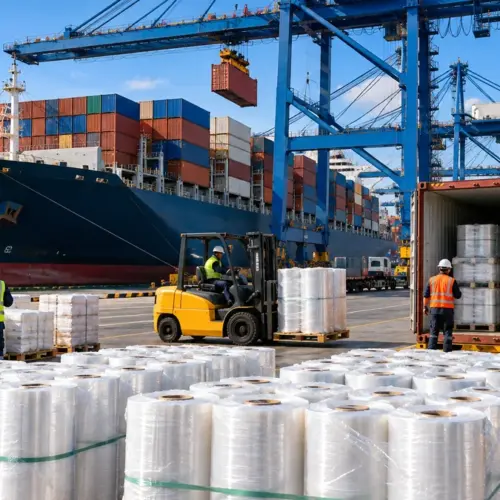
From a logistics standpoint, optimizing container payload is vital to offsetting ocean freight volatility. Standardizing pallet configurations for 40-foot High Cube (40HC) containers allows VN Plastic – Vnplast Global to maximize weight and volume capacity. For stretch film and heavy-duty PE bags, minimizing core weight and optimizing film downgauging (e.g., reducing thickness from 25 microns to 20 microns while retaining dart drop performance via multi-layer co-extrusion) directly reduces ocean freight cost per unit delivered to destination ports.
3. Mandatory Inspection Standards & Compliance Documentation Protocols
Navigating international trade audits requires an unyielding commitment to internationally recognized testing and certification protocols. Global retailers importing HDPE and LDPE packaging must demand complete traceability from resin pellet to finished pallet. VN Plastic enforces rigorous quality control systems aligned with strict ASTM and ISO standards:
- Tensile Strength & Elongation: Tested via ASTM D882 to verify mechanical performance under load, ensuring bags do not fail during retail point-of-sale use.
- Dart Impact Resistance: Evaluated using ASTM D1709 (Free-Falling Dart Method) to measure puncture resistance, critical for industrial stretch film and heavy-duty refuse sacks.
- Thickness & Gauge Uniformity: Measured via digital micrometer arrays compliant with ISO 4593, ensuring downgauged films maintain structural integrity.
- PCR Content Verification & Traceability: Validated through independent third-party audits adhering to Global Recycled Standard (GRS) or Recycled Claim Standard (RCS), complete with mass-balance documentation required by European customs authorities.
Furthermore, shipments must be accompanied by comprehensive documentation packages, including a certified Certificate of Analysis (CoA), Certificate of Origin (C/O) supporting preferential tariff treatment under bilateral or multilateral trade agreements, and REACH compliance declarations guaranteeing the absence of restricted heavy metals and hazardous plasticizers.
4. Shop-Floor Production Realignment & End-to-End Logistics Optimization
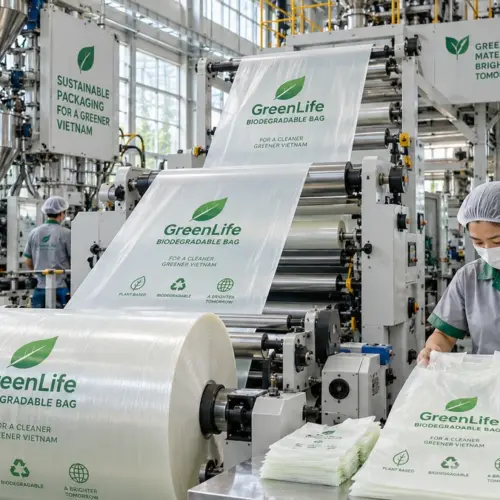
Achieving compliance for 2026 mandates requires extensive shop-floor re-engineering. At VN Plastic, our manufacturing infrastructure has been systematically upgraded to handle high-percentage PCR blends without compromising product aesthetics or performance:
1. Advanced Gravimetric Blending Systems: Multi-component dosing units ensure precise ratios of virgin polymer, PCR masterbatch, and additive packages (such as slip and anti-block agents) are consistently fed into the extruder barrel.
2. Modified Screw and Die Geometries: Barrier screws with specialized mixing heads are deployed to homogenize recycled melts, eliminating gels and unmelted contaminants that cause film bubbles to tear.
3. High-Performance Air Rings: Dual-lip cooling air rings stabilize the bubble immediately upon exiting the die, allowing for tighter tolerance control even when processing variable recycled resins.
On the logistics side, end-to-end supply chain visibility is maintained through computerized warehouse management systems (WMS). Finished goods are palletized using automated stretch-hood packaging to prevent moisture ingress and transit shifting during multi-modal transit. Container loading plans are simulated via digital cargo optimization software to eliminate dead space, reducing carbon footprints across ocean and inland legs.
5. Commercial Contract Negotiation & Cross-Border Risk Mitigation
Mitigating risk in international B2B contracts involves careful structuring of Incoterms 2020, raw material indexing clauses, and regulatory liability distribution. Global procurement teams partnering with Vietnamese manufacturers should incorporate the following contractual safeguards:
- Resin Indexing Formulae: To prevent margin erosion caused by feedstock volatility (ICIS-tracked HDPE/LDPE pricing), contracts should feature quarterly adjustment mechanisms linked to public petrochemical indices rather than fixed annual pricing.
- Regulatory Indemnity Clauses: Clear allocation of responsibility regarding EPR compliance documentation. The supplier must legally warrant that the supplied PCR content meets statutory definitions in the destination market, shielding the importer from unexpected eco-tax penalties.
- Incoterms Alignment: Utilizing FOB (Free on Board) or DDP (Delivered Duty Paid) structures depending on the buyer’s internal logistics capabilities. For major enterprise accounts, VN Plastic provides structured DDP execution, absorbing customs clearance complexities and managing destination port logistics directly.
- Force Majeure & Port Congestion Protocols: Explicit frameworks outlining action plans for unexpected disruptions in major transshipment hubs, ensuring alternative routing options are pre-approved.
6. Strategic Recommendations & Operational Roadmap from VN Plastic – Vnplast Global
To successfully navigate the 2026 regulatory environment, global retailers and packaging distributors must adopt a proactive, integrated sourcing strategy. VN Plastic – Vnplast Global recommends the following four-phase operational roadmap:
1. Immediate Portfolio Audit: Review all current packaging SKUs (HDPE bags, LDPE retail sacks, stretch films) against target market EPR thresholds. Identify products requiring PCR content upgrades or downgauging.
2. Pilot Batch Testing & Certification: Commission sample runs featuring 30% to 50% GRS-certified PCR integration. Subject these samples to rigorous ASTM D882 and ASTM D1709 testing to establish baseline performance benchmarks.
3. Supply Chain Integration: Lock in long-term manufacturing capacity agreements with certified exporters possessing traceable supply chains and documented third-party environmental audits.
4. Continuous Regulatory Monitoring: Establish a joint compliance committee with manufacturing partners to track upcoming regulatory shifts in the EU, UK, and North America, ensuring proactive adaptation ahead of legislative deadlines.
By partnering with an experienced manufacturer capable of balancing technical precision, regulatory compliance, and cost-optimized logistics, global enterprises can turn 2026 EPR mandates into a distinct competitive advantage.
Technical & Quality Compliance Advisory from VN Plastic – Vnplast Global
For international procurement directors, supply chain partners, and B2B buyers, rigorous pre-shipment sample testing (CoA/CoC) and accredited independent inspection (SGS/Intertek) are paramount prior to contract execution. Contact our technical desk for complete engineering datasheets and tailored FOB/CIF quotation schedules.