1. Global Market Dynamics & Emerging Non-Tariff Regulatory Barriers
When you search for a reliable HDPE LDPE bags EPR compliance, The regulatory landscape for flexible packaging importers in North America and the European Union has shifted fundamentally. Entering 2026, Extended Producer Responsibility (EPR) frameworks are no longer restricted to broad conceptual policy frameworks; they have materialized as rigorous, penalty-backed non-tariff trade barriers. Major retail conglomerates and multinational brand owners importing high-density polyethylene (HDPE), low-density polyethylene (LDPE) bags, and linear low-density stretch film face punitive eco-modulation fees tied directly to virgin resin usage, recyclability indices, and post-consumer recycled (PCR) content thresholds.
In the European Union, the revised Packaging and Packaging Waste Regulation (PPWR) enforces mandatory PCR content minimums reaching up to 30% to 35% for contact-sensitive and non-contact flexible film applications by 2030, with interim compliance audit metrics active in 2026. Simultaneously, various U.S. states including California, New Jersey, Maine, and Oregon have operationalized comprehensive EPR programs. These states require producers to finance municipal recycling collection streams through escalating fee schedules that penalize unrecyclable multi-material laminates and reward mono-material structures like monolithic HDPE shopping bags and cast or blown LDPE stretch film.
For international procurement desks, sourcing from high-capacity export manufacturing hubs requires a profound shift. Traditional cost-per-kilogram purchasing models must now integrate total compliance costs, including eco-fees, certificate traceability, and lifecycle carbon accounting. Factories that fail to adapt their blown-film extrusion lines to process certified PCR materials seamlessly while maintaining mechanical tensile strength risk losing access to tier-one global supply chains. (Compliance verified under International ISO Trade Quality Standards).
2. Quantitative Impact on Operational Margins & Freight Cost Structures
The financial implications of 2026 EPR mandates cascade directly down the balance sheets of multinational procurement divisions. Eco-modulation fees under European and North American schemes can add anywhere from 15% to 45% to the landed cost of non-compliant plastic packaging lines. Importers relying strictly on virgin petrochemical-derived HDPE and LDPE bags are experiencing severe margin compression due to these escalating tax structures.
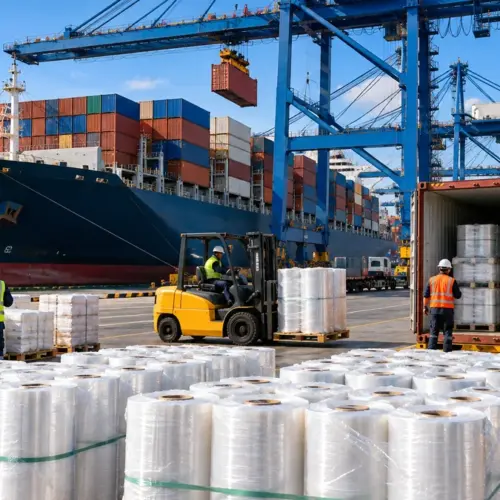
Concurrently, ocean freight economics for bulk flexible packaging have experienced renewed volatility driven by geopolitical chokepoints, shifting carrier alliances, and strict maritime decarbonization regulations like FuelEU Maritime and IMO carbon intensity rating systems. Average 40-foot High Cube (40HC) container spot rates from major Asian export hubs to Rotterdam and Los Angeles fluctuate between $2,400 and $4,200 depending on quarterly alliance capacity adjustments.
| Container Type & Route | Average Ocean Freight Cost (USD) | Port Handling & D&D Surcharges (USD) | Estimated EPR Eco-Fee Impact (per MT) | Total Landed Cost Variance vs. 2024 |
|---|---|---|---|---|
| 40HC: Asia to Rotterdam (EU) | $3,150 – $3,850 | $450 – $650 | €180 – €320 ($195 – $350) | +22.4% |
| 40HC: Asia to Los Angeles (US) | $2,600 – $3,300 | $380 – $520 | $140 – $280 (State Tiered) | +18.7% |
| 20GP: Intra-Asia Regional Feed | $950 – $1,400 | $180 – $250 | Variable ($50 – $120) | +8.2% |
To mitigate these compounding logistics and regulatory expenses, supply chain directors must optimize container payload efficiency. By re-engineering film thickness (down-gauging) through advanced multi-layer co-extrusion technology—reducing standard LDPE stretch film gauges from 23 microns down to 17 microns without sacrificing dart drop impact resistance or holding force—importers can load up to 28 metric tons per 40HC container, effectively diluting freight costs per unit while minimizing total packaging mass subject to EPR fee calculations.
3. Mandatory Inspection Standards & Compliance Documentation Protocols
Satisfying 2026 border customs controls and environmental enforcement agencies requires an uncompromised documentation trail. Importers of HDPE/LDPE bags and industrial stretch film can no longer rely on generic factory declarations of conformity. Regulatory bodies demand verifiable third-party testing credentials mapped directly against internationally recognized standards.
“`
[Raw Material Input] —> [Extrusion & Conversion] —> [Laboratory Testing] —> [Certification Audit] —> [Customs Clearance]
(Virgin + Certified PCR) (HDPE/LDPE Blown Film) (ASTM D1709 / ISO 527) (ISCC PLUS / Global Recycled Standard) (EPR Compliance Dossier)
“`
Key testing benchmarks that must accompany each commercial shipping batch include:
- Mechanical Performance Standards: ASTM D1709 (Dart Drop Impact Resistance for film toughness), ASTM D882 (Tensile Properties of thin plastic sheeting), and Elmendorf Tear Testing (ASTM D1922) to prove that PCR-integrated films maintain structural integrity.
- Material Composition and Traceability: ISCC PLUS (International Sustainability and Carbon Certification) or GRS (Global Recycled Standard) transaction certificates tracking post-consumer resin feedstock from verified recycling collection points back to the extrusion floor.
- Migration and Heavy Metal Compliance: EN 13432 or equivalent heavy metal thresholds (lead, cadmium, mercury, hexavalent chromium under sum < 100 ppm) for packaging materials entering regulated retail food and consumer goods sectors.
Failure to present these certificates upon arrival at destination ports results in extended quarantine holds, heavy customs demurrage charges, and potential cargo rejection or mandatory re-exportation at the importer’s expense.
4. Shop-Floor Production Realignment & End-to-End Logistics Optimization
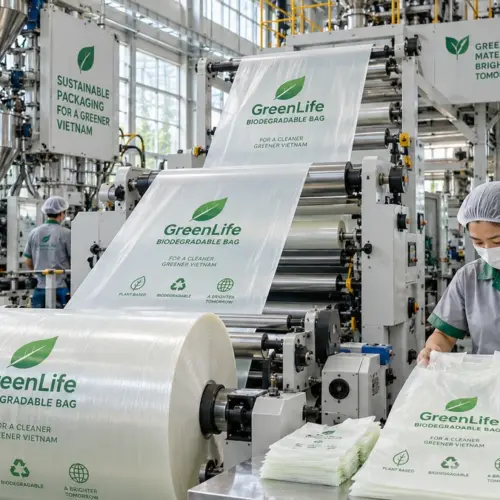
Achieving compliance with stringent global standards necessitates direct intervention at the manufacturing level. Extruding high-percentage PCR-blended HDPE and LDPE films introduces significant processing challenges compared to virgin polyolefins, including melt flow index (MFI) variability, gel formation, and tensile inconsistency.
Advanced manufacturing facilities, exemplified by VN Plastic – Vnplast Global operations, address these shop-floor realities through strict technological upgrades:
1. Gravimetric Blending Systems: Multi-component dosing units are installed directly on blown-film lines to ensure precise ratios of virgin resin, masterbatch additives, and PCR pellets, eliminating gauge variation across the bubble.
2. Enhanced Filtration Screen Changers: Continuous self-cleaning hydraulic screen changers with filtration ratings down to 100-150 mesh remove micro-contaminants present in recycled feedstocks, preventing bubble tears and pinholes in ultra-thin film production.
3. Optimized Cooling Rings and Bubble Stability: Dual-lip air rings paired with internal bubble cooling (IBC) systems maintain stable frost line heights, ensuring optimal orientation and crystalline structure formation for high-performance stretch film and heavy-duty trash bags.
Logistically, packaging must be optimized to survive long-haul maritime transport without degradation. Palletization configurations must utilize heavy-duty corrugated edge protectors, anti-slip interleave sheets, and UV-inhibited stretch hood films to prevent moisture ingress, solar thermal degradation, and transit shift during multi-week ocean voyages.
5. Commercial Contract Negotiation & Cross-Border Risk Mitigation
Mitigating risk in international trade agreements involving sustainable polymer packaging requires precise legal and commercial safeguards embedded within Sales and Purchase Agreements (SPAs) and Incoterms 2020 definitions.
- Incoterms Selection: For high-volume ocean freight, CIF (Cost, Insurance, and Freight) or FOB (Free on Board) structures should be negotiated with clear demarcation of demurrage/detention liabilities. Given ongoing port congestions, securing a minimum of 14 to 21 demurrage-free days at the destination port is vital.
- Quality Discrepancy & Environmental Penalty Clauses: Contracts must incorporate explicit penalty formulas if delivered batches fail independent laboratory testing for PCR content percentage or tensile performance. Provisions should dictate whether batch rejection triggers immediate air-freighted replacement or a proportional credit memo against future purchase orders.
- Raw Material Indexing: To protect both parties against sudden petrochemical feedstock volatility (ethylene and low-density polyethylene ICIS index fluctuations), procurement desks should implement quarterly sliding-scale pricing mechanisms tied to recognized commodity benchmarks rather than fixed annual pricing that invites supplier default or quality-cutting.
6. Strategic Recommendations & Operational Roadmap from VN Plastic – Vnplast Global
To navigate the complex regulatory environment of 2026 and beyond, global retailers and industrial procurement desks must adopt a proactive, integrated sourcing strategy. VN Plastic – Vnplast Global outlines the following four-step operational roadmap for supply chain leadership:
1. Conduct a Comprehensive Portfolio Audit: Review all existing SKU specifications for HDPE/LDPE bags and stretch film. Categorize packaging items by weight, polymer type, current virgin vs. PCR ratio, and destination market EPR fee exposure.
2. Consolidate with Certified Manufacturers: Partner exclusively with export manufacturers possessing certified chain-of-custody documentation (ISCC PLUS) and proven down-gauging engineering capabilities to lower total mass subject to taxation.
3. Implement Pilot Program Testing: Before committing to full-scale annual volume contracts, execute trial shipments of high-PCR content formulations. Subject these samples to rigorous ASTM/ISO testing under real-world packaging and warehousing conditions.
4. Establish Transparent Data Sharing: Integrate supplier quality management portals with real-time Certificate of Analysis (CoA) and Transaction Certificate (TC) generation to streamline customs clearance and eliminate compliance friction.
By executing this strategic framework, international buyers can future-proof their supply chains, minimize total landed costs, and achieve full compliance with 2026 global environmental mandates without compromising operational efficiency.
Technical & Quality Compliance Advisory from VN Plastic – Vnplast Global
For international procurement directors, supply chain partners, and B2B buyers, rigorous pre-shipment sample testing (CoA/CoC) and accredited independent inspection (SGS/Intertek) are paramount prior to contract execution. Contact our technical desk for complete engineering datasheets and tailored FOB/CIF quotation schedules.