1. Global Market Dynamics & Emerging Non-Tariff Regulatory Barriers
The international secondary packaging market in 2026 is governed by tightening environmental legislation, fluctuating virgin polymer indices, and rigid carbon border adjustment mechanisms. For procurement directors sourcing from a premier machine stretch film wholesale supplier, understanding these macroeconomic pressures is critical to mitigating supply chain disruption. Global resin feedstock markets—specifically Linear Low-Density Polyethylene (LLDPE) melt flow index grades—experience persistent volatility tied to crude oil fluctuations and regional cracker maintenance cycles.
Simultaneously, destination markets across the European Union, North America, and parts of Asia-Pacific have enacted stringent Extended Producer Responsibility (EPR) laws and single-use plastic taxes. Importers can no longer rely on unverified gauge specs or high-micron hand wraps that generate excessive landfill waste. Regulatory frameworks now demand transparent Life Cycle Assessments (LCAs), post-consumer recycled (PCR) content verification, and stringent compliance with heavy metal restrictions (e.g., EU Packaging and Packaging Waste Regulation – PPWR). Partnering with an export-oriented manufacturer like VN Plastic – Vnplast Global ensures full alignment with these complex, non-tariff regulatory hurdles through rigorous material formulation and audited production chains.
2. Quantitative Impact on Operational Margins & Freight Cost Structures
Evaluating the total cost of ownership (TCO) between machine-grade and hand-grade stretch film requires granular examination of film consumption per pallet load. Hand stretch film application relies on human ergonomics, typically yielding a limited pre-stretch percentage of 50% to 80%. This manual variation leads to inconsistent containment force, excessive film usage, and higher vulnerability to transit damage during long-haul container shipping. (Compliance verified under International ISO Trade Quality Standards).
Conversely, automated wrapping equipment utilizing high-performance 5-layer cast machine stretch film allows for pre-stretch levels ranging from 200% up to 300%. When a 20-micron machine film is pre-stretched by 250%, its effective thickness decreases on the load while its tensile recovery secures the pallet with optimized holding force.
| Parameter | Hand Stretch Film (Manual) | Machine Stretch Film (Automated) |
|---|---|---|
| Typical Pre-Stretch Capability | 50% – 80% | 200% – 300% |
| Average Film Consumption / Pallet | 450g – 650g | 180g – 280g |
| Containment Force Consistency | Highly Variable (Operator Dependent) | Uniform & Calibrated |
| Cost-Per-Pallet Wrapped | High (Excessive Material Waste) | Low (Optimized Yield) |
| Container Space Utilization | Moderate | High (Denser Load Stability) |
From a freight optimization standpoint, reducing film weight per pallet directly lowers the carbon footprint and optimizes warehouse throughput. Furthermore, machine stretch films provide superior load stability, drastically decreasing cargo claims and insurance premiums during intermodal transit.
3. Mandatory Inspection Standards & Compliance Documentation Protocols
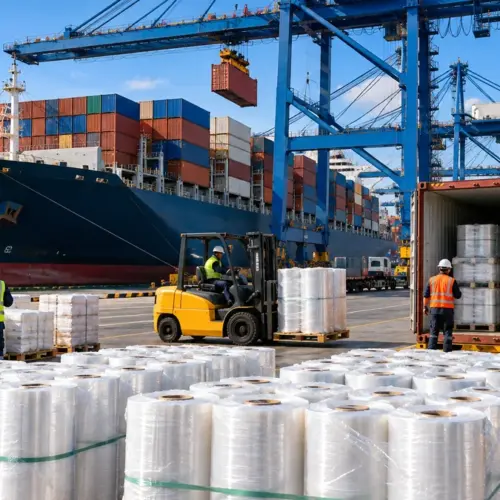
International procurement desks must enforce rigorous Quality Assurance (QA) and Quality Control (QC) protocols before dispatching 40-foot high-cube (40HC) containers from origin ports. Industrial-grade machine stretch film must be evaluated against standardized testing methodologies to guarantee puncture resistance, dart drop impact, tear propagation, and ultimate tensile strength.
Key compliance standards governing export-grade stretch film include:
- ASTM D882: Standard Test Method for Tensile Properties of Thin Plastic Sheeting.
- ASTM D1922: Standard Test Method for Propagation Tear Resistance of Plastic Film and Thin Sheeting by Pendulum Method.
- ASTM D1709: Standard Test Method for Impact Resistance of Plastic Film by the Free-Falling Dart Method.
When importing from a certified wholesale supplier, procurement teams must demand Mill Test Certificates (MTCs) and Certificate of Analysis (COA) documents for every master batch production run. Additionally, export documentation must feature precise HS codes, verified gross mass (VGM) declarations per SOLAS regulations, and origin declarations to secure preferential tariff treatment under bilateral free trade agreements (e.g., EVFTA, RCEP).
4. Shop-Floor Production Realignment & End-to-End Logistics Optimization
Transitioning warehouse operations from manual application to automated machine wrapping necessitates a coordinated realignment of shop-floor infrastructure and supply chain logistics. Automated wrapping turntables and rotary arm systems require specific film roll specifications, including consistent core diameters (typically 3 inches), precise roll weight thresholds, and flawless slit edges to prevent web breaks during high-speed revolutions.
At the manufacturing level, VN Plastic – Vnplast Global leverages state-of-the-art 5-layer cast extrusion lines. This advanced co-extrusion technology enables the strategic integration of metallocene LLDPE resins in outer skin layers for exceptional cling and puncture resistance, while core layers utilize high-strength polymers to maintain structural integrity under high tension.
Logistically, coordinating export schedules from major Vietnamese logistics hubs requires meticulous planning:
- Port of Origin: FOB Hai Phong or Cat Lai (Ho Chi Minh City).
- Transit Lead Times: Typically 14–28 days to major Asia-Pacific destinations, and 30–45 days to European and North American ports.
- Minimum Order Quantity (MOQ): Standardized at one 20-foot container load (20GP) to optimize maritime freight economies of scale, mixed with varying widths (500mm standard) and thicknesses (15micron to 35micron).
5. Commercial Contract Negotiation & Cross-Border Risk Mitigation
Structuring a resilient B2B supply agreement for stretch film procurement requires precise Incoterms 2020 alignment, raw material indexation clauses, and robust force majeure definitions. Given the inherent volatility of petrochemical feedstock, fixed-price contracts exceeding 90 days expose both buyers and manufacturers to severe margin compression or supply default risks.
Smart procurement strategies incorporate sliding-scale pricing formulas tied directly to ICIS (Independent Chemical Information Service) regional LLDPE indices. Furthermore, contracts must explicitly detail defect liability thresholds, specifying acceptable tolerances for gauge variation (within ±5%), roll length accuracy, and pallet packaging integrity during ocean transit.
Dispute resolution mechanisms should designate neutral arbitration bodies, while payment terms must favor secure international instruments such as Irrevocable Letter of Credit (LC) at sight or documents against payment (DP), minimizing financial counterparty risk across cross-border jurisdictions.
6. Strategic Recommendations & Operational Roadmap from VN Plastic – Vnplast Global
To capture maximum operational efficiency and cost reduction in 2026, global logistics importers must execute a structured transition roadmap:
1. Audit Current Packaging Lines: Conduct a comprehensive audit of existing pallet-wrapping processes to calculate baseline film consumption and identify ergonomic bottlenecks associated with hand-grade application.
2. Upgrade to 5-Layer Cast Technology: Partner directly with an established machine stretch film wholesale supplier like VN Plastic – Vnplast Global to test high-performance, ultra-thin machine films capable of 250%+ pre-stretch.
3. Consolidate Container Shipments: Leverage strategic FOB Hai Phong and Cat Lai shipping lanes to consolidate full container loads (FCL), reducing per-unit ocean freight costs and minimizing carbon emissions.
4. Establish Long-Term Supply Frameworks: Implement index-linked commercial contracts that ensure raw material price transparency, guaranteed factory capacity allocation, and strict adherence to ASTM and ISO international quality standards.
By executing this disciplined procurement framework, multinational enterprises can future-proof their supply chains, eliminate packaging waste, and achieve sustainable cost optimization across global distribution networks.
Technical & Quality Compliance Advisory from VN Plastic – Vnplast Global
For international procurement directors, supply chain partners, and B2B buyers, rigorous pre-shipment sample testing (CoA/CoC) and accredited independent inspection (SGS/Intertek) are paramount prior to contract execution. Contact our technical desk for complete engineering datasheets and tailored FOB/CIF quotation schedules.