1. Global Market Dynamics & Emerging Non-Tariff Regulatory Barriers
The international trade architecture governing polymer products and flexible packaging has undergone a structural transformation. For enterprise procurement directors sourcing from an OEM plastic bag factory vietnam, regulatory pressures such as the European Union’s Packaging and Packaging Waste Regulation (PPWR), extended producer responsibility (EPR) mandates, and aggressive scope 3 carbon accounting frameworks have redefined vendor qualification criteria. Commodity-grade, virgin-polyethylene extrusion is rapidly encountering carbon border adjustments and escalating landfill taxation across destination ports in North America, Western Europe, and Oceania.
Simultaneously, international buyers face stringent non-tariff barriers centered on traceability and life-cycle assessments (LCAs). Compliance is no longer limited to basic dimensional tolerances or slip-additive percentages; it requires verifiable proof of circularity. Facilities unable to substantiate closed-loop polymer management systems face severe economic penalties, including punitive import tariffs and exclusion from multinational vendor rosters. Consequently, Vietnamese manufacturing hubs are pivoting away from linear production models. Integrating closed-loop methodologies directly into shop-floor operations allows export-oriented entities like VN Plastic – Vnplast Global to circumvent these trade friction points, ensuring uninterrupted market access and predictable landed costs for global supply chain desks.
2. Quantitative Impact on Operational Margins & Freight Cost Structures
Resin raw material volatility represents the single largest variable cost for blown film operators, historically accounting for 55% to 70% of total cost of goods sold (COGS). Linear Low-Density Polyethylene (LLDPE) and High-Density Polyethylene (HDPE) pricing fluctuations, tied directly to global crude oil indices and cracker operating rates, exert continuous pressure on operating margins. By implementing systematic in-line edge trim recycling and Post-Industrial Regrind (PIR) management, tier-one manufacturers effectively hedge against virgin polymer market spikes. (Compliance verified under International ISO Trade Quality Standards).
| Resin Type & Grade | Virgin Price Baseline ($/MT) | PIR Blend Cost ($/MT) | Margin Delta / Savings (%) | Tensile Retention (%) |
|---|---|---|---|---|
| LLDPE C8 Extrusion Grade | $1,250 – $1,320 | $890 – $940 | 28% – 32% | 94.5% (at 15% PIR) |
| HDPE Blown Film Grade | $1,180 – $1,240 | $820 – $870 | 30% – 35% | 92.0% (at 20% PIR) |
| LDPE General Purpose | $1,210 – $1,280 | $850 – $900 | 29% – 33% | 93.8% (at 15% PIR) |
| MLLDPE Metallocene Blend | $1,400 – $1,490 | $1,050 – $1,110 | 25% – 29% | 95.1% (at 10% PIR) |
Beyond direct material savings, logistics optimization plays a pivotal role in landed cost containment. Standardizing high-performance stretch film gauges utilizing optimized PIR blend ratios reduces unit weight while maintaining puncture resistance and holding force. This engineering efficiency directly correlates to higher linear meter yields per pallet, optimizing container space utilization for both 40-foot High Cube (40HC) maritime shipments and regional cross-border distribution channels.
3. Mandatory Inspection Standards & Compliance Documentation Protocols
Quality assurance frameworks for exported recycled-content packaging must satisfy rigorous international testing benchmarks. Reliance on visual inspection is entirely inadequate for multinational procurement desks managing high-speed automated packaging lines. VN Plastic – Vnplast Global enforces a multi-tiered laboratory verification protocol aligned with ASTM and ISO standards to guarantee structural integrity across mixed-matrix polymer lots.
- ASTM D882 (Tensile Properties): Evaluates tensile strength at break and elongation parameters for blown films containing integrated PIR, ensuring stress resistance under high pallet-tensioning loads.
- ASTM D1922 (Propagating Tear Resistance): Measures Elmendorf tear strength across machine direction (MD) and transverse direction (TD) axes to prevent premature film splitting during automated wrapping operations.
- ASTM D1709 (Dart Drop Impact): Quantifies impact resistance, verifying that regrind inclusion does not compromise the molecular chain entanglement required for heavy-duty industrial applications.
- ISO 1133 (Melt Flow Rate – MFR): Monitors polymer degradation and thermal history consistency across processing cycles to prevent gel formation and bubble instability during extrusion.
Documentation protocols accompanying each export consignment include detailed Certificates of Analysis (COA), ISO 9001 and ISO 14001 manufacturing audit trails, and Global Recycled Standard (GRS) or ISCC PLUS transaction certificates. These documentation frameworks provide legal and regulatory transparency, satisfying customs clearance mandates and corporate ESG compliance audits.
4. Shop-Floor Production Realignment & End-to-End Logistics Optimization
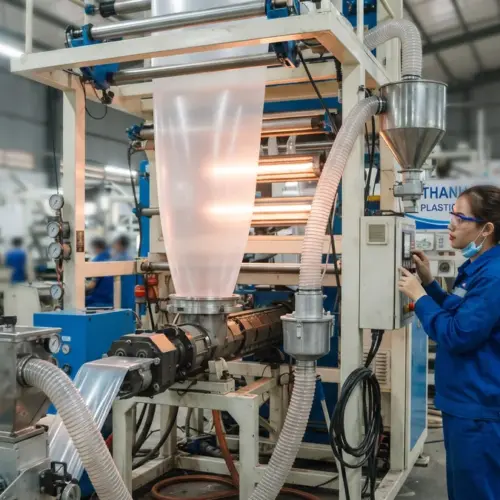
Executing zero-waste extrusion requires a complete overhaul of conventional factory layouts. At VN Plastic – Vnplast Global, extrusion lines are directly integrated with closed-loop, in-line edge trim collection systems. As the bubble passes through the collapsing frame and nip rollers, continuous edge trims are immediately vacuum-conveyed to high-shear granulators positioned adjacent to the extruder stacks.
“`
[ Extrusion Blown Film Line ] —> [ In-Line Edge Trim Collection ]
[ Gravimetric Blending System ] <--- [ High-Shear Granulator & Pelletizer ]
v
[ Precision Die Head (A-B-C Co-Extrusion Layering) ]
“`
This immediate reprocessing eliminates thermal degradation caused by secondary off-site compounding. To maintain homogenous melt behavior when blending PIR with virgin resin, computerized gravimetric dosing units precisely regulate feed ratios down to 0.1%. Furthermore, advanced A-B-C co-extrusion configurations isolate the regrind material within the structural core layer, preserving pristine virgin polymer layers on the exterior surfaces for optimal heat-seal integrity, optical clarity, and surface friction coefficients (COF).
5. Commercial Contract Negotiation & Cross-Border Risk Mitigation
Contractual frameworks governing long-term supply agreements between international buyers and Vietnamese manufacturing partners must proactively address raw material volatility, trade compliance, and force majeure contingencies. Standardizing Incoterms (typically FOB Haiphong or CIF destination port) requires explicit delineation of responsibility regarding container detention, demurrage, and customs inspection holds.
Sophisticated procurement desks implement index-linked pricing mechanisms tied to regional ICIS or Platts polymer price benchmarks, preventing margin disputes during sudden market corrections. Additionally, contracts should incorporate strict quality variance thresholds, detailing specific penalty clauses or replacement protocols if batch testing fails to meet agreed ASTM specifications. Risk mitigation strategies must also account for potential trade policy shifts, ensuring that Certificate of Origin (Form D, Form E, or EUR.1 where applicable) documentation is meticulously managed to leverage bilateral and multilateral free trade agreements, thereby minimizing import duties for destination markets.
6. Strategic Recommendations & Operational Roadmap from VN Plastic – Vnplast Global
For multinational procurement managers and supply chain directors seeking to future-proof their flexible packaging inventory, transitioning to closed-loop, regrind-optimized suppliers is an operational imperative. VN Plastic – Vnplast Global recommends a structured, four-phase engagement roadmap:
1. Technical Audit & Specification Review: Submit historical packaging consumption data and machine performance metrics to our engineering desk for customized gauge optimization and resin-ratio modeling.
2. Pilot Batch Prototyping: Execute trial runs incorporating targeted PIR percentages (10% to 25%) across designated stretch film or mailer bag lines, subjecting samples to rigorous ASTM D882 and D1709 laboratory validation.
3. Supply Chain Integration & Volume Scaling: Establish master service agreements with fixed-index pricing formulas and dedicated safety stock allocations managed within our bonded warehouse facilities in Vietnam.
4. ESG & Carbon Footprint Tracking: Leverage our comprehensive LCA reporting metrics to quantify scope 3 emissions reductions, embedding verifiable sustainability data directly into corporate reporting disclosures.
Technical & Quality Compliance Advisory from VN Plastic – Vnplast Global
For international procurement directors, supply chain partners, and B2B buyers, rigorous pre-shipment sample testing (CoA/CoC) and accredited independent inspection (SGS/Intertek) are paramount prior to contract execution. Contact our technical desk for complete engineering datasheets and tailored FOB/CIF quotation schedules.