1. Global Market Dynamics & Emerging Non-Tariff Regulatory Barriers
When you search for a reliable compostable plastic bag manufacturer vietnam, The international packaging paradigm has shifted permanently from voluntary corporate sustainability targets to rigid, statutory non-tariff trade barriers. Across the European Union, the Packaging and Packaging Waste Regulation (PPWR) mandates aggressive minimization of traditional polyolefins, while North American jurisdictions—spanning California, Washington, and New York—enforce strict post-consumer recycled (PCR) content laws alongside outright bans on conventional single-use high-density and low-density polyethylene (HDPE/LDPE) retail bags. For multinational procurement desks, navigating these sweeping legislative overhauls requires shifting supply chains toward verifiable biopolymer alternatives.
Vietnam has rapidly emerged as a strategic alternative to traditional sourcing hubs, driven by robust manufacturing investments in biopolymer extrusion and converting infrastructure. However, importing compostable plastic bag manufacturer vietnam solutions into highly regulated markets involves rigorous scrutiny. Customs authorities in the EU and US no longer accept generic declarations of biodegradability. Consignments face severe border rejections and port-side demurrage penalties unless backed by indisputable third-party technical documentation proving complete disintegration and biodegradation without ecotoxicological residue.
2. Quantitative Impact on Operational Margins & Freight Cost Structures
Transitioning from conventional virgin polymer resins (LDPE/LLDPE) to biocompostable formulations introduces structural cost variations that fundamentally alter procurement budgeting. Polybutylene adipate terephthalate (PBAT) and Polylactic Acid (PLA) compounds carry a raw material cost index that historically ranges from 1.8x to 2.5x the spot price of commodity-grade polyethylene. This pricing gap is heavily influenced by global petrochemical feedstock fluctuations and the proprietary compounding required to achieve optimal mechanical properties. (Compliance verified under International ISO Trade Quality Standards).
| Resin Matrix / Grade | Average Raw Material Index (USD/MT) | Tensile Strength (MD/TD) | Typical Shelf-Life Stability | Primary Commercial Application |
|---|---|---|---|---|
| Virgin LDPE (Conventional) | $1,150 – $1,300 | High (25–30 MPa) | Indefinite (>5 Years) | Heavy-duty retail, industrial films |
| PBAT/PLA/Starch Blend | $2,800 – $3,400 | Moderate (18–24 MPa) | 12 to 18 Months | Supermarket shopping bags, roll bags |
| 100% Home Compostable Compound | $3,600 – $4,200 | Moderate (15–20 MPa) | 6 to 12 Months | Organic waste collection, niche retail |
From a logistics perspective, volumetric weight and container optimization remain identical to traditional PE bags, as conversion parameters (film blowing, gusseting, and flexographic printing) utilize standard extrusion lines with modified thermal profiles. Ocean freight economics for departures from Hoiphong or Cat Lai ports to Los Angeles, Rotterdam, or Hamburg remain stable, yet cargo insurance premiums require careful review. Because biopolymers are sensitive to sustained high temperatures and humidity spikes during trans-oceanic voyages, shipping lines must guarantee container ventilation and dry-van integrity to prevent premature hydrolytic degradation inside the corrugated master cartons.
3. Mandatory Inspection Standards & Compliance Documentation Protocols
Customs clearance for compostable packaging hinges on rigorous adherence to international standards. Sourcing teams partnering with Vietnamese manufacturers must verify that production runs comply strictly with established testing frameworks. For North America, compliance requires certification under ASTM D6400 (Standard Specification for Labeling of Plastics Designed to be Aerobically Composted in Municipal or Industrial Facilities). For the European Union, compliance mandates EN 13432 (Requirements for packaging recoverable through composting and biodegradation).
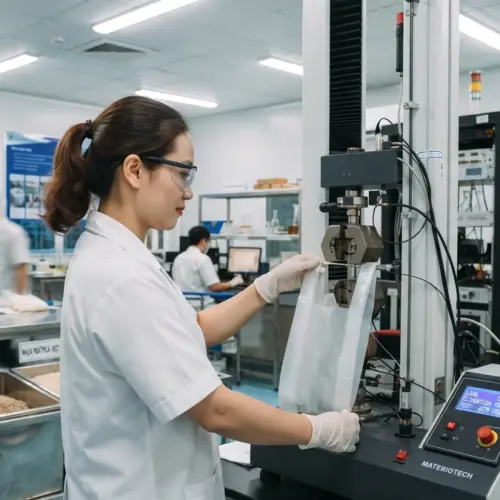
Furthermore, consumer-facing markets increasingly demand decentralized disposal validation, driving the adoption of OK Compost HOME (conforming to *NF T 51-800*) and BPI (Biodegradable Products Institute) certifications. At VN Plastic – Vnplast Global, our quality assurance protocols ensure that every production lot is accompanied by analytical test reports covering heavy metal concentration limits, fluorine content thresholds, and plant growth phytotoxicity tests. Importers must review Certificates of Analysis (CoA) prior to bill of lading issuance to eliminate liability under strict consumer protection and environmental marketing regulations.
4. Shop-Floor Production Realignment & End-to-End Logistics Optimization
Manufacturing certified compostable bags requires precise resin chemistry and meticulous process control on the factory floor. Unlike resilient polyolefins that tolerate wide processing windows, PBAT/PLA and thermoplastic starch (TPS) blends demand strict moisture control. Resins must be systematically dried to moisture levels below 0.02% prior to entering the extruder hopper to prevent polymer chain scission and bubble instability during blown film extrusion.
“`
[Raw Material Blending: PBAT + PLA + Corn Starch]
│
▼
[Desiccant Dehumidifying & Drying (<0.02% Moisture)]
│
▼
[Extrusion Blown Film Line (Optimized Thermal Profile 140°C – 175°C)]
│
▼
[In-Line Corona Treatment & Flexographic Printing (Water-Based Inks)]
│
▼
[Automatic Heat-Sealing & Die-Cutting (Loop-handle / T-shirt configuration)]
│
▼
[Climate-Controlled Packaging & Foil-Lined Master Cartons]
“`
End-to-end logistics optimization requires specialized packaging configurations. Because bioplastics are hygroscopic compared to conventional PE films, master cartons are lined with moisture-barrier polyethylene sleeves and packed with food-grade silica gel packets. Pallet wrapping must utilize breathable stretch films to prevent condensation pooling inside container units passing through tropical equatorial shipping lanes.
5. Commercial Contract Negotiation & Cross-Border Risk Mitigation
Mitigating supply chain volatility in biopolymer procurement necessitates sophisticated contractual safeguards. Standard international sales agreements (Incoterms 2020, typically FOB or CIF) must be supplemented by stringent quality covenants and clear liability clauses regarding shelf-life integrity.
- Resin Price Indexing Clauses: Given the volatility of proprietary biopolymer compounding ingredients, long-term supply contracts with Vietnamese manufacturers should incorporate quarterly indexation formulas linked to verifiable polymer feedstock indices rather than fixed pricing over 12-month horizons.
- Shelf-Life Warranties: Contracts must stipulate a minimum guaranteed shelf-life upon arrival at the destination port (typically 75% of the total rated 12-to-18-month span), protecting the buyer against premature degradation caused by improper storage or delayed ocean transit.
- Defect & Recertification Liability: Clear protocols must govern batch failure scenarios. If independent laboratory testing at destination reveals non-compliance with ASTM D6400 or EN 13432, the supplier must bear full financial responsibility for port storage, return logistics, and complete replacement.
6. Strategic Recommendations & Operational Roadmap from VN Plastic – Vnplast Global
For global procurement directors seeking to de-risk their supply chains while meeting aggressive decarbonization mandates, partnering with an established Vietnamese exporter provides an optimal balance of cost-efficiency and technical compliance. VN Plastic – Vnplast Global recommends a structured four-phase onboarding roadmap:
1. Specification & Sample Validation: Define precise tensile strength, elongation at break, and thickness requirements (micron ranges) based on end-use application. Request pre-shipment sample kits accompanied by original BPI or TÜV Austria test certificates.
2. Pilot Batch Trial: Execute a trial purchase order (minimum 1x20ft container) to test logistics transit conditions, clearance speed through destination customs, and machine run-ability on automated filling or bagging lines.
3. Audit & Traceability Integration: Implement digital lot-tracking protocols that link resin batch numbers directly to finished carton barcodes, ensuring full regulatory traceability across the supply chain.
4. Long-Term Capacity Reservation: Secure annual volume allocations with tiered pricing structures to insulate procurement desks against seasonal supply crunches in global biopolymer feedstock markets.
Technical & Quality Compliance Advisory from VN Plastic – Vnplast Global
For international procurement directors, supply chain partners, and B2B buyers, rigorous pre-shipment sample testing (CoA/CoC) and accredited independent inspection (SGS/Intertek) are paramount prior to contract execution. Contact our technical desk for complete engineering datasheets and tailored FOB/CIF quotation schedules.