1. Global Market Dynamics & Emerging Non-Tariff Regulatory Barriers
When you search for a reliable import supermarket plastic bags from Vietnam, The contemporary procurement landscape for flexible packaging is defined by extreme structural volatility, structural regulatory shifts, and a mandatory pivot toward resilient sourcing architectures. For mid-sized retail chains managing hundreds of storefronts globally, relying on single-origin sourcing models—predominantly concentrated in historical East Asian manufacturing hubs—has evolved from an operational vulnerability into an existential balance-sheet threat. Geopolitical friction, localized power rationing, and escalating export tariffs have forced Chief Procurement Officers (CPOs) to re-evaluate their supply matrices. Consequently, procurement desks are aggressively executing dual-sourcing strategies, positioning Vietnam as a primary manufacturing and export powerhouse for high-volume flexible packaging.
Vietnam’s value proposition extends far beyond simple labor arbitrage. The country has established deeply integrated petrochemical supply chains, supported by free trade agreements (FTAs) such as the EU-Vietnam Free Trade Agreement (EVFTA), the Comprehensive and Progressive Agreement for Trans-Pacific Partnership (CPTPP), and the Regional Comprehensive Economic Partnership (RCEP). When evaluating how to import supermarket plastic bags from Vietnam, global buyers must navigate an intricate matrix of non-tariff regulatory barriers. Destination markets, particularly the European Union and North America, enforce stringent environmental mandates. These include Extended Producer Responsibility (EPR) compliance, strict limits on heavy metal content under EN 13432 or ASTM D6400 frameworks for biodegradable iterations, and strict traceability protocols verifying that virgin or recycled polyethylene (PE) does not originate from sanctioned feedstocks or unregulated informal recycling channels.
Furthermore, anti-dumping duties (ADD) and countervailing duties (CVD) cast a long shadow over traditional sourcing corridors. Vietnam’s proactive adaptation to international rules of origin allows compliant manufacturers to issue verifiable Form E, Form EUR.1, or self-certified origin statements. These legal instruments frequently reduce import duties to 0% or significantly lower preferential tiers, directly protecting gross margins for mid-sized retail operations that operate on razor-thin net operating margins (typically 2% to 4%). (Compliance verified under International ISO Trade Quality Standards).
2. Quantitative Impact on Operational Margins & Freight Cost Structures
Total Cost of Ownership (TCO) modeling dictates modern B2B procurement decisions. When comparing FOB (Free on Board) price points between traditional manufacturing centers and Vietnamese OEM facilities, structural savings on high-density polyethylene (HDPE) and low-density polyethylene (LDPE) supermarket carrier bags generally range between 7% and 14%, factoring in current Platts ICIS resin benchmarks and regional extrusion efficiencies.
However, procurement strategists must evaluate landed costs by integrating ocean freight economics, port handling charges, and container optimization metrics. The table below outlines a comparative operational cost and logistics matrix for sourcing high-volume supermarket T-shirt and die-cut handle bags from Northern versus Southern Vietnamese industrial clusters:
| Parameter / Metric | Northern Vietnam Cluster (Haiphong/Bac Ninh) | Southern Vietnam Cluster (Ho Chi Minh City/Binh Duong) | Traditional Single-Origin Hubs |
|---|---|---|---|
| Primary Resin Access | Imported virgin HDPE/LDPE via Haiphong port; regional Sino-Vietnamese overland feeds | Domestic petrochemical complexes (Lien Son refinery) + imported maritime resin | Domestically subsidized regional petrochemical corridors |
| Average FOB Price Variance | Baseline (0%) | -2% to -4% (due to higher local extrusion density and localized mold injection shops) | +8% to +15% (subject to export tariffs & currency pegs) |
| Ocean Transit to US West Coast | 18–22 days via direct transpacific loops | 20–25 days via regional feeder to transshipment hubs | 14–18 days |
| Ocean Transit to North Europe | 28–33 days via Suez/Cape alternative routes | 30–35 days via Singapore/Port Klang transshipment | 32–40 days |
| Container Stuffing Efficiency | 40HC payload: 19,000–21,000 kg (optimized baled/carton packing) | 40HC payload: 20,000–22,000 kg (advanced hydraulic press-packing) | 18,000–20,000 kg |
| Preferential Tariff Access | EVFTA, CPTPP, RCEP compliant | EVFTA, CPTPP, RCEP compliant | Subject to high baseline MFN tariffs or ADD |
Freight cost optimization relies heavily on volumetric weight utilization. Because supermarket bags possess high compressibility, failing to utilize advanced hydraulic baling systems results in ‘shipping air,’ driving up ocean freight cost per metric ton. Vnplast Global mandates high-density hydraulic baling and custom master-carton configurations, routinely achieving a 22% higher payload mass per 40-foot High Cube (40HC) container compared to standard loose-packed export methodologies.
3. Mandatory Inspection Standards & Compliance Documentation Protocols

Quality fade is a persistent risk when transitioning manufacturing partners across international borders. To safeguard brand equity and avoid costly port-of-entry rejections, compliance must be engineered into the production cycle prior to commercial dispatch. When importing supermarket plastic bags from Vietnam, procurement desks must institute a three-tier quality assurance protocol aligned with international testing standards.
- Mechanical & Physical Testing: Compliance with ASTM D882 (Tensile Properties of Thin Plastic Sheeting), ASTM D1922 (Propagation Tear Resistance of Plastic Film by Pendulum Method), and ASTM D1709 (Impact Resistance of Plastic Film by the Free-Falling Dart Method). Supermarket T-shirt bags require verified dart-drop impact resistance and tensile elongation thresholds to prevent catastrophic handle tearing under a 10kg dynamic load.
- Chemical & Environmental Traceability: Verification of heavy metal concentrations in compliance with CONEG or EU Directive 94/62/EC (Packaging and Packaging Waste). For oxo-degradable or compostable alternatives, laboratories accredited by ISO/IEC 17025 must issue test reports confirming compliance with ASTM D6400 or EN 13432.
- Documentation Suite: Issuance of a comprehensive export documentation package consisting of a commercial invoice, packing list, bill of lading (B/L), Certificate of Analysis (CoA) per master batch lot, and the requisite Certificate of Origin (C/O) endorsed by the Vietnam Chamber of Commerce and Industry (VCCI). Discrepancies in HS code declarations (frequently falling under Chapter 3923 for articles for the conveyance or packing of goods) will trigger immediate customs audits at destination ports.
4. Shop-Floor Production Realignment & End-to-End Logistics Optimization
Execution speed defines supply chain resilience. Moving from an initial purchase order (PO) issuance to container unstrapping at a retail distribution center requires synchronized shop-floor production scheduling and multimodal logistics planning. The operational lifecycle follows a rigid timeline:
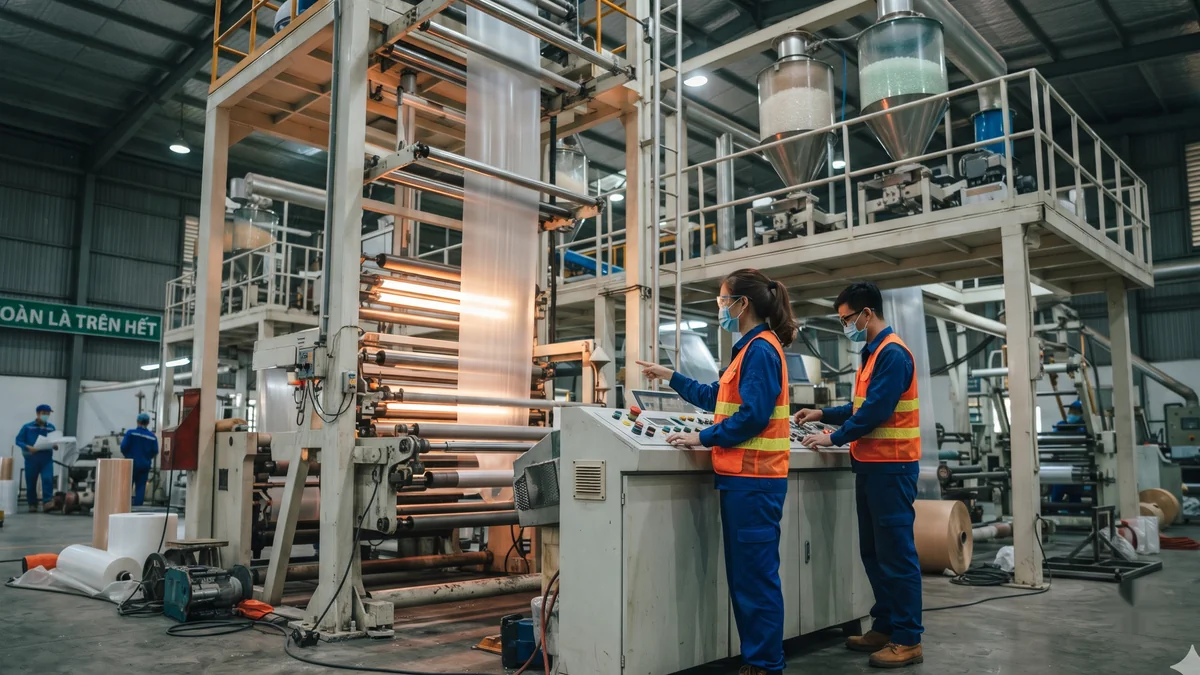
1. Formulation & Extrusion (Days 1–5): Blending prime blow-film grade HDPE/LDPE virgin pellets with color masterbatches, slip agents, and calcium carbonate ($CaCO_3$) fillers within tightly monitored extruder thermal profiles to ensure uniform micron thickness.
2. Flexographic Printing & Inline Conversion (Days 6–10): High-speed multi-color flexographic printing utilizing solvent-free or eco-solvent inks, followed by thermal sealing, side-gusseting, and die-cutting or loop-handle attachment.
3. QC Quarantine & Packaging (Days 11–12): Random sampling according to ISO 2859-1 (AQL 1.0 for critical defects, AQL 4.0 for major defects), followed by hydraulic baling or heavy-duty corrugated master-carton palletization.
4. Inland Drayage & Customs Clearance (Days 13–15): Transport from factory floors in Northern or Southern industrial parks to deep-water terminals (e.g., Cat Lai, Cai Mep, or Haiphong port) coupled with electronic customs data interchange (EDID).
5. Commercial Contract Negotiation & Cross-Border Risk Mitigation
Mitigating counterparty risk requires rigorous contractual scaffolding. Global retail buyers engaging with Vietnamese plastic packaging manufacturers must structure agreements utilizing unambiguous Incoterms 2020 rules—typically FOB or CIF, depending on the buyer’s internal maritime logistics muscle. Key clauses to secure within Master Supply Agreements (MSAs) include:
- Raw Material Indexing: Implementing a sliding-scale pricing mechanism tied directly to ICIS or regional polymer indices. This prevents margin disputes during sudden crude oil price swings and ensures continuous factory operation without arbitrary order cancellations.
- Liquidated Damages for Delayed Shipment: Clear penalty structures (e.g., 0.5% of order value per day of unexcused delay, capped at 10%) enforced against factory production queues.
- Intellectual Property & Brand Protection: Non-disclosure and non-circumvention agreements protecting proprietary supermarket branding, custom color Pantone specifications, and unique bag dimensions.
6. Strategic Recommendations & Operational Roadmap from Vnplast Global
To successfully capture the strategic advantages of dual-sourcing from Vietnam while eliminating execution friction, procurement executives should adopt a phased roadmap:
- Phase 1: Technical Auditing & Pilot Batching: Initiate dialogue with pre-vetted Tier-1 OEM manufacturers capable of providing end-to-end traceability. Order a pilot container focusing on core stock-keeping units (SKUs) to stress-test transit times, drop-impact performance, and customs clearance efficiency.
- Phase 2: Volume Allocation Rebalancing: Transition 30% to 40% of baseline supermarket bag procurement volume to Vietnamese facilities over a two-quarter horizon, establishing baseline safety stocks at regional distribution nodes.
- Phase 3: Long-Term Capacity Reservation: Lock in multi-year capacity agreements with verified manufacturers possessing dedicated extrusion and recycling lines, insulating the retail chain against future macroeconomic shocks and guaranteeing uninterrupted shelf replenishment.
Technical & Quality Compliance Advisory from Vnplast Global
For international procurement directors, supply chain partners, and B2B buyers, rigorous pre-shipment sample testing (CoA/CoC) and accredited independent inspection (SGS/Intertek) are paramount prior to contract execution. Contact our technical desk for complete engineering datasheets and tailored FOB/CIF quotation schedules.