The European retail landscape has fundamentally shifted away from conventional polyolefins, driven by the Single-Use Plastics (SUP) Directive and aggressive corporate Scope 3 emission targets. For international procurement desks, securing compliant compostable bags wholesale requires navigating a complex labyrinth of non-tariff regulatory barriers.
1. Global Market Dynamics & Emerging Non-Tariff Regulatory Barriers
The European retail landscape has fundamentally shifted away from conventional polyolefins, driven by the Single-Use Plastics (SUP) Directive and aggressive corporate Scope 3 emission targets. For international procurement desks, securing compliant compostable bags wholesale requires navigating a complex labyrinth of non-tariff regulatory barriers. Major European supermarket chains—particularly across Germany, France, and the Benelux union—no longer accept generic biodegradable claims; they demand rigorous, third-party verified proof of complete biodegradation without toxic ecotoxicity residues.
At Vnplast Global, our dialogue with multinational retail category managers reveals that compliance is no longer a localized checkbox but a baseline prerequisite for supplier tender qualification. Non-tariff barriers now encompass strict Extended Producer Responsibility (EPR) fee structures, mandatory lifecycle assessments (LCAs), and stringent proof of origin for renewable biomass content. Vietnam has emerged as a premier export hub for bioplastic packaging, leveraging advanced extrusion infrastructure and strategic access to international resin markets. However, failing to align Vietnamese manufacturing operations with rigorous European standards results in immediate port-of-entry rejections, severe financial penalties, and irreversible brand erosion for retail buyers.
2. Quantitative Impact on Operational Margins & Freight Cost Structures
Sourcing biopolymer films introduces distinct economic variables compared to traditional High-Density Polyethylene (HDPE) or Low-Density Polyethylene (LDPE). Raw material input costs for certified compostable formulations—primarily Polybutylene Adipate Terephthalate (PBAT) blended with Thermoplastic Starch (TPS) and PLA—trade at a significant premium over petroleum-based counterparts. Below is an analytical cost-structure comparison highlighting the structural divergence between conventional and compostable bag manufacturing:
| Cost Component | Conventional PE Bags (HDPE/LDPE) | Certified Compostable Bags (PBAT/TPS/PLA) | Variance Impact on Procurement |
|---|---|---|---|
| Raw Resin Index (USD/MT) | $1,100 – $1,350 (Petroleum-linked) | $2,800 – $3,400 (Biopolymer-linked) | +115% to +150% baseline material inflation |
| Extrusion Energy Consumption | Standard temperature profile (160°C – 200°C) | Narrow processing window (130°C – 175°C) | +15% energy overhead due to precise thermal control |
| Cycle Time & Line Speeds | High-speed blown film extrusion | Reduced line speed to prevent film sagging | -20% to -30% output volume per machine hour |
| Ocean Freight (40HC Dry Van) | Standard ambient container management | Climate-controlled or desiccated container specs | Marginal increase for moisture-absorbent lining |
| EPR Compliance Fees (EU) | High penalty tiers for non-recyclable plastics | Exempt or significantly reduced eco-modulation tiers | Net operational savings at retail point-of-sale |
For enterprise procurement teams, absorbing the initial material cost delta requires optimizing supply chain efficiencies upstream. By consolidating bulk manufacturing runs at Vnplast Global’s automated facilities in Vietnam, buyers can offset resin price volatility through tiered volume-rebate structures and optimized container space utilization.
3. Mandatory Inspection Standards & Compliance Documentation Protocols

Securing wholesale distribution contracts within the European Union mandates strict adherence to dual-tier certification frameworks: EN 13432 for industrial composting and OK compost HOME (or equivalent AS 5810 standards) for backyard degradation. Procuring compliance documentation requires a rigorous audit trail covering chemical characterization, biodegradation, disintegration, and ecotoxicity testing.
1. Stage 1: Chemical Characterization & Heavy Metal Screening: Raw resin compounds and masterbatches must undergo inductively coupled plasma mass spectrometry (ICP-MS) to guarantee that heavy metals (such as cadmium, lead, mercury, and zinc) remain strictly below threshold limits set by EN 13432.
2. Stage 2: Ultimate Aerobic Biodegradability Testing: The material must demonstrate at least 90% conversion into carbon dioxide, water, and biomass within a maximum timeframe of 180 days under controlled laboratory composting conditions.
3. Stage 3: Disintegration & Physical Fragmentation Analysis: During industrial composting simulation, less than 10% of the original dry mass of the bag can remain on a 2mm sieve after 12 weeks of exposure.
4. Stage 4: Ecotoxicity & Plant Growth Bioassays: Plant growth tests (utilizing higher plants such as *Lactuca sativa* and barley) must prove that the resulting compost sustains healthy germination rates and biomass production, ensuring zero residual ecotoxicological impact.
4. Shop-Floor Production Realignment & End-to-End Logistics Optimization
Manufacturing export-grade compostable packaging in Southeast Asia introduces specific operational complexities related to the region’s tropical climate. High ambient relative humidity and elevated temperatures accelerate moisture absorption in TPS-rich polymer matrices, posing severe risks during blown-film extrusion, bubble stabilization, and long-term ocean transit.
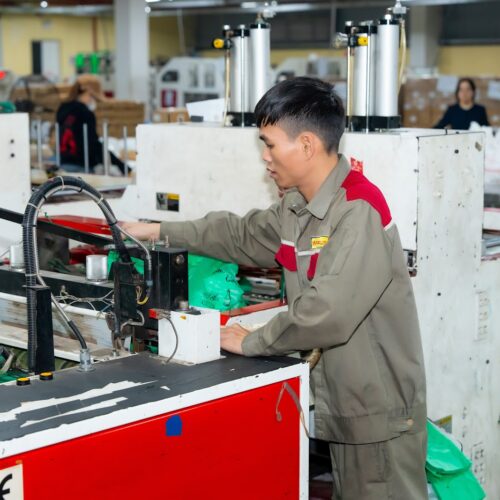
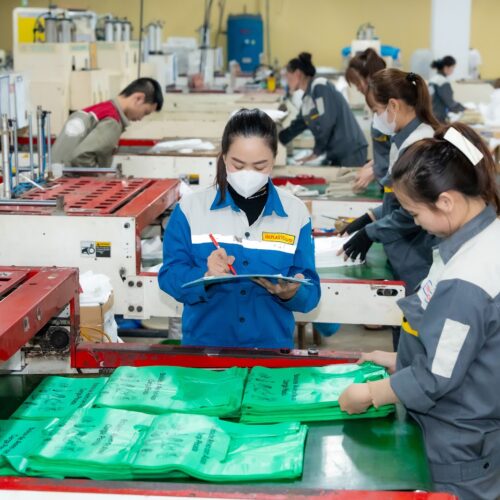
Vnplast Global enforces strict shop-floor environmental controls, maintaining relative humidity below 50% across extrusion and bag-making conversion floors. Furthermore, pre-drying biopolymer resins in dehumidifying crystallizers prior to hopper feeding eliminates moisture-induced bubble tears and gauge variations. For end-to-end logistics, export containers are lined with high-capacity container desiccant blankets, and shipments are routed via direct carrier services to minimize dwell times in high-humidity transshipment ports.
5. Commercial Contract Negotiation & Cross-Border Risk Mitigation
Structuring cross-border B2B supply agreements for compostable packaging demands precision regarding shelf-life warranties, force majeure clauses, and liability allocations. Unlike inert polyethylene, biopolymer films possess a finite structural lifespan influenced by environmental storage conditions. International supply contracts must explicitly stipulate temperature and humidity parameters for warehouse storage (recommended at 15°C to 25°C and under 60% relative humidity).
Procurement directors should mandate clear quality-deficiency remediation protocols in master supply agreements, incorporating independent pre-shipment inspection (PSI) clauses executed by accredited third-party surveyors (e.g., SGS, Bureau Veritas) at the Vietnamese port of loading. Additionally, currency hedging mechanisms and raw material index-linked pricing formulas help stabilize long-term supply agreements against sudden spikes in international PBAT feedstock costs.
6. Strategic Recommendations & Operational Roadmap from Vnplast Global
To capture market share in European retail tenders while mitigating operational risks, procurement executives must execute a structured sourcing roadmap:
1. Phase 1: Supplier Auditing & Technical Qualification: Vet Vietnamese manufacturing partners based on verified TÜV Austria (Seedling, OK compost INDUSTRIAL, OK compost HOME) certification sub-license numbers rather than preliminary supplier declarations.
2. Phase 2: Pilot Batch Optimization & Climate Testing: Commission pilot production runs to test bag tensile strength, seal integrity, and puncture resistance under simulated tropical shipping conditions before scaling to full containerload (FCL) volumes.
3. Phase 3: Extended Producer Responsibility Alignment: Collaborate with suppliers to optimize gauge thickness and printing inks (ensuring heavy-metal-free, water-based flexographic inks) to secure maximum eco-modulation fee discounts across target European markets.
4. Phase 4: Inventory Turnaround Management: Implement a synchronized replenishment schedule with a 90-day maximum inventory turnover threshold in European distribution centers to prevent degradation risks associated with extended warehouse storage.
By partnering with Vnplast Global, international retailers gain direct access to audited manufacturing excellence, full traceability documentation, and resilient supply chain architectures designed to clear European customs and compliance audits seamlessly.
Technical & Quality Compliance Advisory from Vnplast Global
For international procurement directors, supply chain partners, and B2B buyers, rigorous pre-shipment sample testing (CoA/CoC) and accredited independent inspection (SGS/Intertek) are paramount prior to contract execution. Contact our technical desk for complete engineering datasheets and tailored FOB/CIF quotation schedules.
Key Operational Advantages of Compostable Bags Wholesale
- High Retention Force: Consistent load stabilization preventing pallet shifting during transit.
- Puncture & Tear Resistance: Exceptional resistance against sharp pallet corners and rough handling.
- Material Efficiency: High pre-stretch capability delivers up to 30% reduction in plastic consumption.
- Regulatory Compliance: 100% prime virgin raw material meeting RoHS, REACH, and FDA safety benchmarks.
Frequently Asked Questions (FAQ) Regarding Compostable Bags Wholesale
Question 1: What is the standard production manufacturing lead-time for compostable bags wholesale export orders?
Answer: Under standard factory operating capacity, production and loading for compostable bags wholesale container consignments are completed within 10 to 14 business days from deposit or L/C confirmation.
Question 2: Are pre-shipment evaluation samples of compostable bags wholesale provided with official laboratory test reports?
Answer: Yes, complimentary sample kits of certified compostable bags wholesale accompanied by full Certificate of Analysis (CoA) reports are dispatched internationally within 3 to 5 business days via DHL/FedEx.
Question 3: Which Incoterms 2020 terms and payment methods are supported for compostable bags wholesale orders?
Answer: We provide standard FOB Cát Lái/Hải Phòng as well as CIF worldwide gateway ports for all compostable bags wholesale shipments, supported by Irrevocable Letters of Credit (L/C at sight) or T/T payment terms.