1. Global Market Dynamics & Emerging Non-Tariff Regulatory Barriers
When you search for a reliable vietnam plastic bags free trade agreement tariffs, The global flexible packaging market, specifically for polyethylene (PE) bags, custom high-density polyethylene (HDPE) mailers, low-density polyethylene (LDPE) shrink films, and cast or blown machine-grade stretch films, faces an unprecedented structural transformation. Traditional sourcing corridors dominated by mainland Chinese and Indian manufacturers are encountering severe friction due to tightening geopolitical trade barriers, anti-dumping duties (ADD), and compensatory countervailing duties (CVD) imposed by importing economies in North America, the European Union, and Oceania. For multinational procurement desks managing high-volume secondary and tertiary packaging, these tariff penalties have fundamentally eroded historical cost advantages.
Simultaneously, regulatory landscapes within consumer markets are shifting aggressively. The European Union’s Packaging and Packaging Waste Regulation (PPWR), combined with ambitious carbon border adjustment frameworks, requires industrial buyers to scrutinize not only landed cost but also life-cycle carbon footprints, recyclability metrics, and virgin versus post-consumer recycled (PCR) resin ratios. Within this complex operating theater, Vietnam has emerged as a premier manufacturing hub. Backed by a dense network of bilateral and multilateral trade pacts—notably the Comprehensive and Progressive Agreement for Trans-Pacific Partnership (CPTPP) and the European Union-Vietnam Free Trade Agreement (EVFTA)—Vietnamese export-oriented enterprises offer a strategic corridor for risk mitigation.
By leveraging the strategic advantages of vietnam plastic bags free trade agreement tariffs, international buyers can bypass punitive import levies while meeting rigorous international environmental and compliance standards. At VN Plastic – Vnplast Global, our integrated extrusion, printing, and conversion lines are calibrated to serve these demanding specifications, ensuring continuity of supply without exposure to trade penalty shocks.
2. Quantitative Impact on Operational Margins & Freight Cost Structures
When conducting a Total Cost of Ownership (TCO) analysis for industrial packaging commodities, tariff elimination acts as an immediate margin stabilizer. Under standard Most-Favored-Nation (MFN) schedules, importing plastic bags and stretch films into the European Union historically attracted baseline import tariffs ranging from 6.5% to 5.0% depending on the specific CN (Combined Nomenclature) code (e.g., HS codes 3923.21 for polymers of ethylene and 3920.10 for plates, sheets, film, foil, and strip of polymers of ethylene). Under the EVFTA framework, these duties are subject to an accelerated phase-out schedule that culminates in complete tariff elimination (0%), yielding immediate landed cost savings directly translatable to gross margin expansion.
To contextualize the financial impact, consider a mid-to-large-scale European retail distributor importing 500 forty-foot high-cube containers (4076 HC) of blown-film stretch wrap and HDPE grocery bags annually. Assuming an average Free on Board (FOB) cargo valuation of $2,000,000, a standard 6.5% MFN tariff translates to $130,000 in direct cash outflow payable to customs authorities before value-added tax. Securing preferential origin under the EVFTA reduces this duty liability to precisely zero.
| Cost Component | Standard MFN Sourcing (Non-FTA) | VN Plastic EVFTA / CPTPP Preferred Sourcing |
|---|---|---|
| FOB Value (Annualized) | $2,000,000 | $2,000,000 |
| Applicable Import Tariff | 6.5% – 5.0% | 0.0% |
| Tariff Cash Outflow | $100,000 – $130,000 | $0 |
| Ocean Freight (Spot/Contract Mix) | Market Benchmark | Optimized Consolidation (Haiphong/Cat Lai) |
| Anti-Dumping Risk Exposure | High (Vulnerable to sudden ADD/CVD) | Zero (Exempted under FTA frameworks) |
Furthermore, ocean freight dynamics originating from major Vietnamese ports (Hai Phong in the North, Cai Mep and Cat Lai in the South) have stabilized through direct mainline loops to major European hubs (Rotterdam, Antwerp, Hamburg) and North American gateways (Los Angeles, Long Beach, Vancouver). Integrating these freight economics with zero-tariff access creates a highly predictable budget architecture for procurement directors.
3. Mandatory Inspection Standards & Compliance Documentation Protocols
Unlocking preferential tariff benefits is legally contingent upon strict adherence to Rules of Origin (RoO) protocols. Compliance errors routinely lead to customs audits, retroactive duty assessments, and administrative penalties. For polymer converters in Vietnam, qualifying for origin under the EVFTA or CPTPP requires proving that the finished goods satisfy specific product-specific rules (PSR), typically involving a change in tariff heading (CTH) or meeting a Regional Value Content (RVC) threshold.
Because polymer feedstocks—linear low-density polyethylene (LLDPE), low-density polyethylene (LDPE), high-density polyethylene (HDPE), and metallocene grades—are globally traded commodities often sourced from the Middle East, Southeast Asia, or domestic petrochemical complexes (e.g., Nghi Son or Long Son), the conversion process within Vietnam must impart substantial transformation. Extruding resin pellets into blown or cast films, multi-color flexographic printing, and automated gusseting/sealing satisfy the necessary transformation criteria.
“`
[Raw Resin Import / Domestic Petrochemical]
│
▼
[Extrusion & Blown/Cast Film Shop-Floor Conversion]
│
▼
[In-Line Flexo Printing & Bag-Making / Slitting]
│
▼
[Rigid QC Audit: ASTM D882 / ISO 527 Tensile & Dart Drop Testing]
│
▼
[Customs Issuance: Form EUR.1 (EVFTA) or Form VN-A (CPTPP)]
“`
For European Union destinations, the exporter must secure a Certificate of Origin Form EUR.1 issued by the Ministry of Industry and Trade of Vietnam (MoIT), or utilize an approved exporter authorization for consignments exceeding designated value thresholds. For CPTPP destinations (such as Canada, Japan, Australia, and New Zealand), a Declaration of Origin completed by the exporter or producer is standard practice, provided comprehensive bill-of-materials (BOM) tracking and supplier declarations are maintained on file for a minimum mandatory audit period (typically 5 years).
4. Shop-Floor Production Realignment & End-to-End Logistics Optimization
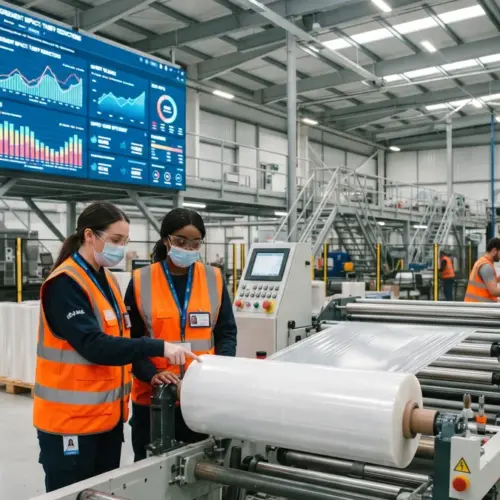
Achieving consistent compliance and high-performance quality benchmarks requires deep shop-floor technological integration. Modern manufacturing lines at VN Plastic – Vnplast Global utilize multi-layer co-extrusion blown film lines equipped with automatic gauge controllers (AGC) and gravimetric dosing units. This ensures uniform micrometer thickness across every roll of stretch film or batch of PE bags, directly supporting end-user requirements for high puncture resistance and tensile strength while minimizing resin consumption.
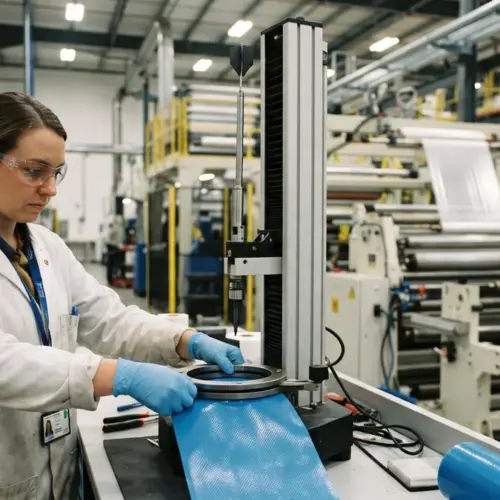
Quality assurance protocols strictly adhere to international testing standards:
- Tensile Strength & Elongation at Break: Verified via ASTM D882 / ISO 527 to ensure stretch wrap withstands pallet load retention forces without snapback failure.
- Dart Drop Impact Resistance: Tested via ASTM D1709 to guarantee heavy-duty PE bags and trash liners resist tearing under shock loads.
- Coefficient of Friction (CoF): Measured via ASTM D1894 to optimize slip properties for high-speed automated packaging machinery.
Logistically, end-to-end orchestration involves pairing factory-floor palletization with heat-shrink hooding and desiccants to prevent container sweat and moisture degradation during maritime transit across equatorial zones. Advanced container loading algorithms maximize internal volume utilization of 40-foot high-cube containers, minimizing unit logistics costs per metric ton of plastic packaging.
5. Commercial Contract Negotiation & Cross-Border Risk Mitigation
International procurement desks navigating multi-year supply agreements must structure commercial contracts to insulate against raw material volatility and regulatory shifts. Standardizing Incoterms 2020 (typically FOB Haiphong/Cai Mep or CIF destination port) establishes unambiguous risk transfer thresholds between VN Plastic and the buyer.
Key contractual mechanisms implemented by seasoned procurement teams include:
1. Resin Indexing Formulae: Linking raw material price adjustments to established regional petrochemical benchmarks (e.g., ICIS or Platts polymer price indices) on a monthly or quarterly review cycle, preventing arbitrary cost markups.
2. Origin Indemnification Clauses: Requiring the manufacturer to guarantee the validity of the Certificate of Origin and assume financial liability for any retroactive duties assessed due to factory-level documentation failures.
3. Force Majeure and Supply Continuity Guarantees: Defining clear protocols for unexpected disruptions, supported by dual-sourcing contingencies and localized buffer stock agreements maintained in regional distribution hubs.
6. Strategic Recommendations & Operational Roadmap from VN Plastic – Vnplast Global
To capitalize on the financial and operational advantages of Vietnamese packaging manufacturing, global procurement organizations should execute a structured, step-by-step onboarding roadmap:
1. Phase 1: Specification Alignment & Technical Audit: Submit current technical data sheets (TDS), drawing schematics, roll dimensions, dart drop requirements, and annual volume forecasts to engineering desks for structural optimization and sample development.
2. Phase 2: Laboratory Sampling & Trial Shipment: Authorize a trial container order (typically a mixed 20-foot or 40-foot high-cube container) to stress-test factory lead times, packaging integrity, and mechanical performance on high-speed client converting/wrapping machinery.
3. Phase 3: Compliance & Origin Verification Review: Validate pre-shipment documentation samples, verifying that HS codes, invoice descriptions, and Certificate of Origin drafts (Form EUR.1 or CPTPP self-certification) align seamlessly with destination customs import parameters.
4. Phase 4: Master Service Agreement (MSA) & Long-Term Capacity Allocation: Lock in multi-quarter volume commitments, establishing dedicated production slots, fixed pricing mechanisms, and continuous supply chains immune to regional trade volatility.
By executing this roadmap with VN Plastic – Vnplast Global, procurement executives secure a resilient, cost-optimized, and legally compliant supply chain that leverages full tariff exemptions under contemporary international trade pacts.
Technical & Quality Compliance Advisory from VN Plastic – Vnplast Global
For international procurement directors, supply chain partners, and B2B buyers, rigorous pre-shipment sample testing (CoA/CoC) and accredited independent inspection (SGS/Intertek) are paramount prior to contract execution. Contact our technical desk for complete engineering datasheets and tailored FOB/CIF quotation schedules.